


About School
The Foundation of Jindal World School
Jindal World School was founded in 1992. A contemporary school that has a truly modern outlook and is yet firmly rooted in Indian values and culture.
The journey of unlearning and relearning that started in the year 2000 has become a lifelong passion for the Founders. As the world keeps changing and evolving, Jindal World School remains a living organism. Jindal World School continuously keeps adapting to remain futuristic, to best serve its students and prepare them for a future of limitless possibilities.
A fundamental curiosity about the very purpose of school education sparked the inception of Jindal World School. Is merely achieving a high score enough to ensure success in life? As homo-sapiens constantly keep evolving, should the schools remain the same in terms of pedagogy, curriculum and learning spaces? How can the internet and advanced technological tools be leveraged to nurture higher-order thinking from a very young age? What kind of skills would be relevant for a future that is unknown and ever-evolving?

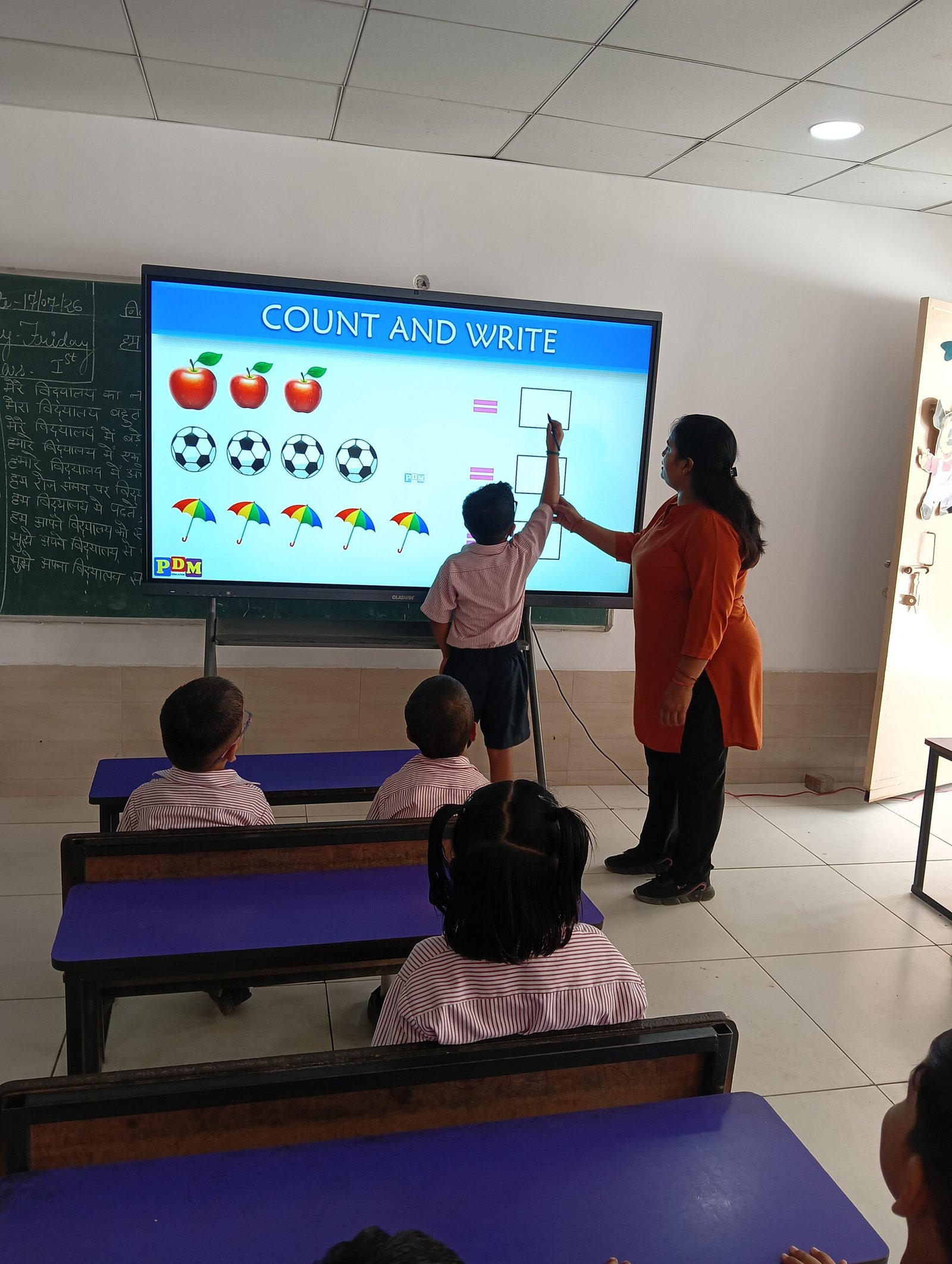

This curiosity led to immersive and fascinating years of unlearning and re-learning. The research journey entailed studying various formats of school education prevalent around the globe, meeting outstanding thinkers from different disciplines, and developing a deep understanding of various modern research in childhood and adolescent education. Thus evolved the pedagogical model for Jindal World School, a model where a teacher is a learner too. A model that offers a conducive environment for students to ‘learn how to learn’ to become ‘life-long learners.
A model that practices ‘learning by doing’. A school where learning is not merely restricted inside the four walls of a classroom or within the boundaries of the school campus. A model that ignites a curious mindset, enabling students to ask unknown questions, even those that at times even teachers do not have the answers to. A reflective framework that helps students build a high ‘Emotional Quotient’ alongside developing high-order cognitive skills.
Once the pedagogical model was evolved, the search started for a curriculum that is contemporary and creative. One that gives equal weightage to the journey as much as it gives to the goal. A curriculum where classroom study always makes connections with real life. A curriculum that throws open-ended questions to nurture critical thinking. A curriculum that celebrates success as well as learning from failures. The Founders discovered that the education offered by the Indian schools could be improved and improved with the school vision and decided to adopt the same.